
Vulvoplasty
If your female dog has experienced ongoing licking, redness, or infections around the back end, she’s not alone. This is a relatively common concern which in some cases can be linked to a condition called a recessed vulva.
Why might vulvoplasty be needed?
A recessed vulva refers to when there are excessive folds of skin covering the vulva. Genetics may play a role in its development in certain breeds, and being overweight can also increase the risk. Delaying speying until after the first heat cycle may help reduce the likelihood of this condition due to the effects of oestrogen on development of normal vulval conformation.
Common Symptoms
In some dogs having a recessed vulva causes no issues. In others, the area may trap moisture when the dog urinates. The resulting damp and warm environment predisposes to the overgrowth of skin bacteria and fungi, leading to irritation and dermatitis. This can then predispose some dogs to urinary tract infections.
Because the severity can vary, signs may differ between dogs. Some may show irritation such as excessive licking or scooting, while others may develop a noticeable odour. Signs of urinary tract inflammation may also occur, including frequent small urinations or straining to urinate.
Treatment
Treatment options are patient dependent. If a patient is overweight, weight loss can help reduce skin folds in the area and improve symptoms. In milder cases, controlling skin infections with medicated wipes or shampoos may be sufficient. However in patients with more severe or persistent problems, a surgical procedure called a vulvoplasty (episioplasty) may be recommended. This involves removing a small crescent shaped section of skin from around the vulva to improve air flow and prevent moisture trapping. This procedure is generally straightforward and well tolerated, and most dogs show significant improvement following recovery.
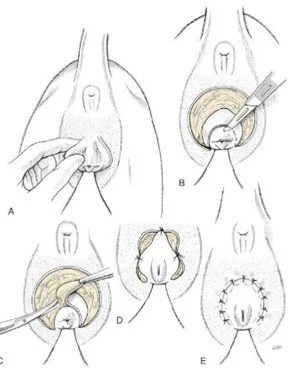
The surgical procedure performed to correct a recessed vulva.