
Cranial Cruciate Disease
The cranial cruciate ligament (CrCL) is one of the key stabilising structures inside the stifle (knee) joint. Disease or rupture of this ligament is one of the most commonly diagnosed orthopaedic conditions in dogs, and is the most frequent cause of hindlimb lameness. Whilst it can occur in cats, it is far less common.
Contributing Factors
CrCL disease is a complex condition, with a number of contributing factors. In many dogs the ligament gradually degenerates and weakens over time, causing it to fray or rupture. Often a sudden injury triggers the onset of lameness, but the underlying weakness has usually been developing for some time. Research also suggests certain breeds, such as Labradors may have a genetic predisposition. Other factors such as obesity and early age desexing may also increase the risk.
Presentation
Dogs with CrCL disease typically present with either a sudden onset of lameness, or a more gradual or even intermittent limp affecting one hind leg. Severity is variable, and can range from a mild limp to complete inability to bear weight on the leg. Occasionally dogs will rupture both cruciate ligaments at the same time and present with severe walking difficulties. Affected dogs may also develop damage to the menisci, the C-shaped cartilages inside the joint that act as shock absorbers.
Diagnosis
Diagnosis usually begins with a thorough veterinary examination. This includes assessing your pet’s gait, checking for muscle loss or asymmetry, joint swelling, instability and any clicking sounds when the joint is moved. In some cases, the condition can be diagnosed during this examination, but many pets require further assessment and X-rays performed under sedation or general anaesthesia.
Treatment
For most dogs with CrCL disease, surgical repair offers the best long term outcome. At Good Boy we perform both TPLO (tibial plateau levelling osteotomy) and extra-capsular repair techniques in house. These differ in their approach and are suited to different patients. The most appropriate option is discussed with owners of affected dogs and a decision made about how best to proceed.
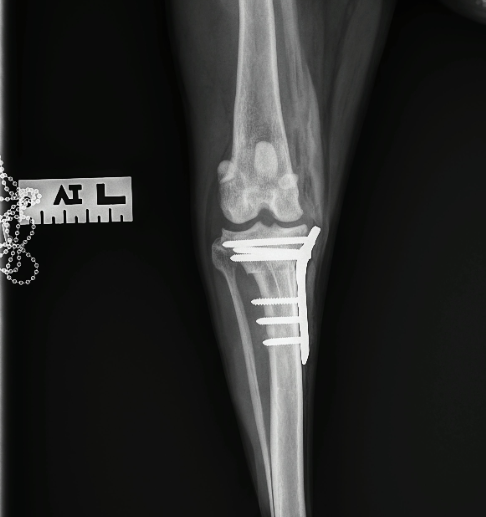
The photo shows a post op radiograph of a TPLO procedure
Medical Therapy
Medical therapy is also an important part of treatment. In some smaller dogs, medical therapy alone may allow a reasonable return to function. In dogs undergoing surgery it is used as an adjunctive treatment. Medical therapy involves activity restriction, weight management, ani-inflammatory and pain relief medications and rehabilitation.
Ongoing
Even after treatment, dogs with CrCL disease are more likely to develop arthritis in the affected joint over time. For this reason, joint supplements and care strategies are often recommended to support mobility and comfort long term.